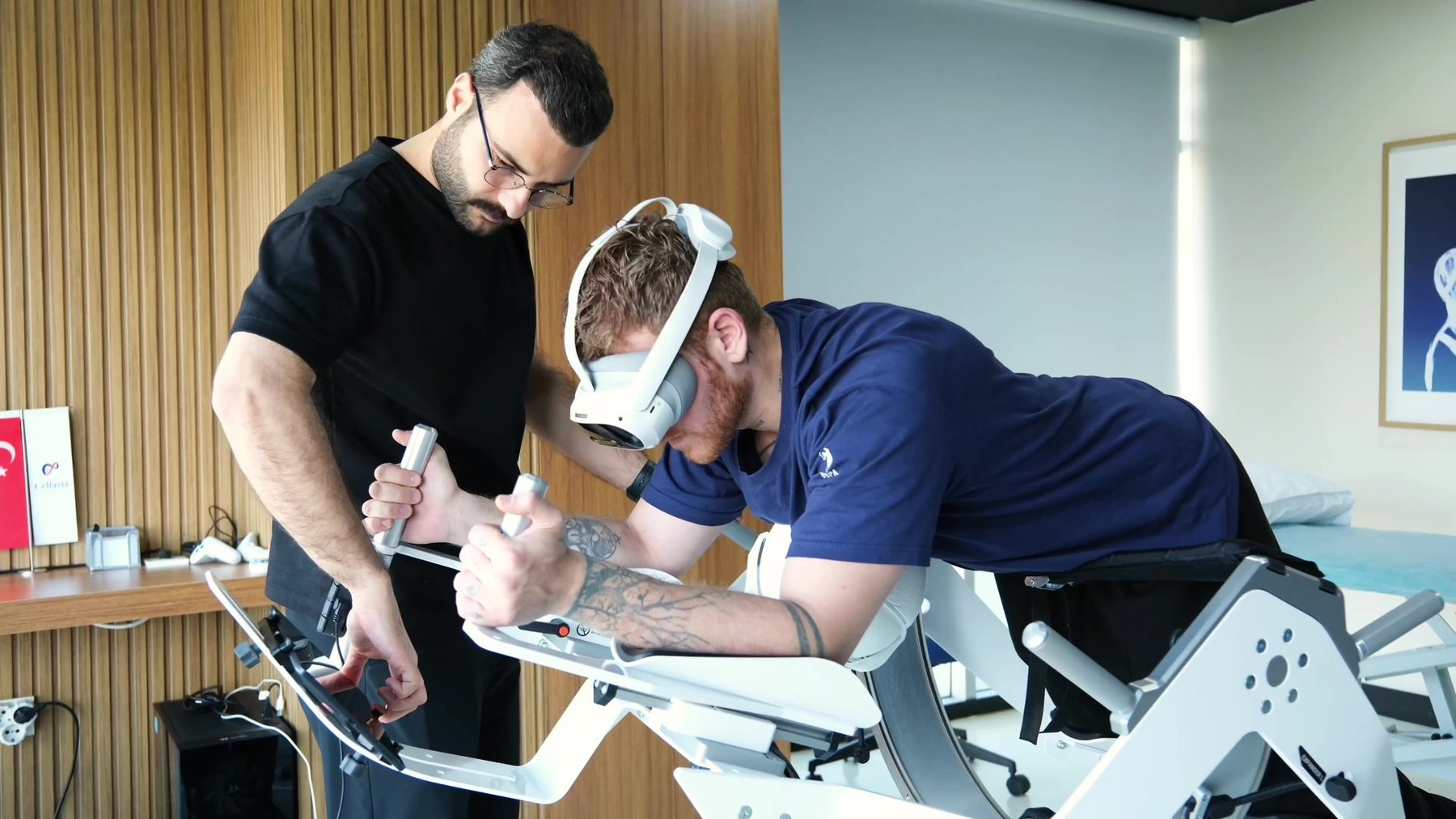
ICAROS is a balance and core platform fused with virtual reality (VR). The person lies on the device and flies or dives in a virtual world by shifting their centre of mass. Changing direction requires using the trunk — so the exercise is the game itself. This article covers the scientific ground of ICAROS, who it suits, and the place of this technology — brought to Turkey for the first time by Cellavia — in the healthy-living camp.
Cellavia’s approach is not gadget curiosity; it is measurement, dosing and specialist accompaniment. ICAROS is integrated into the science and measurement system and the movement health protocol within that frame.
What is ICAROS? Technical and clinical summary
ICAROS Health is a VR-supported neuromotor training system also used in orthopaedic and neurological rehabilitation contexts. The platform translates the user’s trunk movements into virtual navigation. This way:
- Deep trunk (core) muscles work actively
- Balance and proprioception (body-position sense) are stimulated
- Upper-body and shoulder-girdle stabilisation is supported
- Coordination and motor planning are demanded
- Progress is possible with graded resistance levels
The common “boredom and early quit” problem of classical plank or crunch work can ease thanks to VR’s attention-holding scenarios. A ten-minute session often creates concentration and willingness rarely seen in classical core work.
First in Turkey: Cellavia’s ICAROS
ICAROS Health technology was brought to Turkey for the first time by Cellavia. The aim is to place a system used in European rehabilitation and performance centres into a measurable, safe and scientific protocol within longevity, biohacking and healthy-living camp contexts.
This “first” claim is not a decorative marketing sentence; it aligns with Cellavia’s technology selection criterion: chosen not because it is trendy, but because it trains neuromotor control, core quality and motivation at once. Camp intro: Healthy-living camp Antalya guide.
Scientific rationale: why VR + core can work
1. Neuromotor learning
The brain learns task-oriented, feedback-rich movement faster. VR can accelerate motor learning with instant visual feedback. The user gets the “right feel” not from an abstract instruction, but from success in the flight/dive scenario.
2. Proprioception and balance
Balance is not only standing upright; it is central processing of information from joint and muscle spindles. ICAROS demands continuous micro-corrections through the trunk — challenging and training the balance system.
3. The “real” function of the core
The core’s job is not endless sit-ups; it is stabilising the spine during movement. Because direction change on ICAROS comes through the trunk, stabilisation sits in a more functional context than isolation exercise.
4. Motivation and adherence
One of the biggest barriers in exercise science is sustainability. VR can positively affect perceived effort and willingness to participate — raising protocol adherence. As adherence rises, physiological benefit potential also rises.
What gains does ICAROS target?
- Deep trunk muscle activation and endurance
- Balance, coordination and reaction quality
- Postural control and shoulder–trunk connection
- Focus and cognitive–motor synchrony
- A progression step after rehabilitation (by specialist decision)
Outcomes vary by person, session frequency, resistance setting and accompanying osteopathy/physiotherapy plan. There is no miracle promise; there is measured practice.
Safety, contraindications and specialist accompaniment
At Cellavia, ICAROS is applied with a physiotherapist. First sessions keep resistance low; vestibular (balance) sensitivity, nausea, dizziness and spinal discomfort are monitored. Pre-assessment is required in the following cases:
- Acute low-back/neck pain or recent injury
- Serious vestibular disorder / severe migraine attacks
- Uncontrolled hypertension or advanced cardiac restriction
- Pregnancy
- Epilepsy history (regarding VR triggers)
- Recent surgery or physician restriction
This article is not medical advice. The personal physician and camp team assess suitability together.
ICAROS’s place in the camp protocol
In the 7-day programme, ICAROS sits in a movement-quality block timed not to clash with cold/heat hormesis days and vegetative recovery. Dose is set after osteopathic assessment. This separates “trying the technology” from “working to personal capacity”.
ICAROS fits the measure → apply → re-measure loop in our scientific biohacking approach: after a session, perceived effort, balance feel and next-day recovery are monitored.
ICAROS vs classical core: which is better?
Wrong question. The right question: for which aim, at which dose, for whom?
- Classical strength work is strong for hypertrophy and maximal strength.
- ICAROS is strong for neuromotor control, balance and task-oriented core.
- Osteopathy / mobility is critical for opening restrictions and carrying load safely.
Cellavia uses these as complements, not rivals.
Common mistakes
- Choosing high resistance from day one
- Ignoring form breakdown in VR excitement
- Forcing the session while dizzy
- Treating ICAROS as “all the core you need”
- Skipping measurement and specialist feedback
For whom is it especially meaningful?
Desk workers, those sensing postural issues, people wanting better balance and core quality, those seeking controlled progression after rehab, and adults who find VR motivational. In performance athletes it can be a neuromotor layer complementing classical training.
Experience ICAROS at the Cellavia camp
ICAROS Health — brought to Turkey for the first time by Cellavia — with a physiotherapist and personalised dosing.
Request a pre-consultation Explore the programmeFAQ
Where was ICAROS first used in Turkey?
The ICAROS Health system was brought to Turkey by Cellavia. It is offered as part of the scientific movement protocol in the Antalya Göynük healthy-living camp and the Cellavia ecosystem.
Is ICAROS a game console?
No. Virtual reality is a motivation layer; the real aim is training deep trunk muscles, balance, coordination and neuromotor control. It is applied with a physiotherapist.
How long is an ICAROS session?
A typical focused session is around 10 minutes; intensity, resistance level and the person’s capacity are adjusted individually.
Who can use ICAROS?
It suits many healthy adults. Vestibular sensitivity, acute spinal issues, pregnancy and some neurological/orthopaedic conditions require specialist assessment.
Does ICAROS replace gym core work?
It is a complementary neuromotor and core tool. Think of it as a quality and motor-control layer — not a replacement for classical strength training.
This article is for information only and is not medical advice, diagnosis or treatment. Make health decisions with your physician.